White, pink, and brown noise are three ways of spreading sound energy across low and high pitches. White noise gives every frequency an equal share, so it sounds like a bright hiss. Pink noise tilts toward the low end and sounds more like steady rain. Brown noise tilts further and sounds like a deep rumble. None of them is proven to improve sleep, and the research is limited and mixed. If one helps you relax and covers the hallway, pick it by ear and keep it low.
If your feed keeps playing you hiss, rain, and rumble, the algorithm has been working as your unpaid sound designer. Here is what it was mixing.
What “color” means for noise
The color describes the shape of the sound, not a mood. Picture a fence of pitches, deepest bass at one end and highest hiss at the other, and a can of paint standing in for sound energy. A noise color is a rule for spreading the paint.
White noise puts the same amount on every foot of fence: equal power at every frequency, so 40 to 60 hertz carries as much as 400 to 420. But your ears hear in octaves, and an octave is a doubling of pitch. Each octave up covers twice as much fence as the one below, so it gets twice the paint. The top end dominates, which is why white noise sounds hissy.
Pink noise gives each octave the same share instead, as much power from 40 to 60 hertz as from 4,000 to 6,000. Every step up the scale sounds about as full as the last.
Brown noise tips the can toward the bass. Its energy falls off twice as steeply as pink’s, so the low end takes over. And brown is named for Brownian motion, after the botanist Robert Brown, not the color.
How each one sounds
White noise is static, as Cleveland Clinic sleep psychologist Michelle Drerup, PsyD, puts it. Think of an air vent with ambition.
Pink noise is softer and lower. Northwestern Medicine compares it to rustling leaves, steady rainfall, or ocean waves.
Brown noise is the deepest: a rumbling roar, in Northwestern Medicine’s words, like a strong waterfall, heavy rainfall, or distant thunder. Metropolitan Acoustics, an acoustics firm, adds that many people find brown more pleasing.
None of these is the correct answer. If you like the hiss, the hiss is allowed.
What about green noise?
Green noise is the newer label in sleep apps, and it is not a standard color like white, pink, and brown. Reference lists file it under informal definitions, with several unrelated meanings. One description in those lists says it is marketed as “the background noise of the world,” similar to pink with extra energy around 500 hertz, in the middle of the range.
So treat “green noise” as a name, not a spec, and expect apps to differ. If you like the whoosh, that is reason enough.
Brown noise and pink noise for sleep
If you searched for brown noise for sleep, you may have wanted something to press play on. Long tracks are easy to find on video sites and in apps. Brown noise for sleep is simply the deep spectrum above, played for a long time. Cleveland Clinic notes that its popularity comes mainly from social media testimonials, and that it is too soon to tell how helpful it is.
Pink noise for sleep has more science attached to its name, but that science mostly tested something other than a pink noise video. More on that below.
Rain, ocean, and thunderstorm sounds
Rain, ocean, and thunder tracks are the nature-documentary cousins of colored noise, and many land near pink or brown. The NHS lists background sounds like rainfall among things to try in the bedroom. No recorded wave holds a healing frequency. The appeal is steadiness and a sound you enjoy. One caution: sudden thunder cracks are the very kind of spike that masking is meant to hide. If the booms make you twitch, pick a steady downpour.
Masking, not magic
A quiet room makes every small sound stand out: a door down the hall, a partner’s snore. A steady sound raises the floor, so the sudden noise has less silence to jump out of. As Drerup puts it, “That consistent noise creates a masking effect that blocks out sudden noises that might cause you to wake up.”
The color mostly changes how that cover feels. Northwestern Medicine suggests brown for people bothered by low sounds, like a furnace kicking on.
What the research actually found
In 2021, University of Pennsylvania researchers published a systematic review of 38 studies on continuous white noise and similar broadband noise as a sleep aid. Results ranged from noise improving sleep to noise disrupting it. Under a standard grading system, the quality of evidence that continuous noise improves sleep was very low. The authors called for better research before promoting noise as a sleep aid, especially since it may also negatively affect sleep and hearing.
That does not mean noise never helps. It means nobody can promise it will help you. If your brown noise habit works, keep it sensible.
Pink noise and deep sleep: the fine print
Headlines say pink noise boosts deep sleep or memory. The studies behind that are real, and they look nothing like a track left on all night.
In a 2013 German study, brief sounds timed in step with sleepers’ slow brain waves during deep sleep strengthened that rhythm and improved memory for what people had learned. Sounds out of step did not help.
A 2017 Northwestern study tried this with 13 healthy adults aged 60 to 84. A computer tracked their brain waves and sent short pink noise pulses right when the next wave was predicted. Word recall improved more overnight than after a sham night, though deep-sleep activity across the whole night was similar on both.
A pink noise video cannot see your brain waves. Roneil Malkani, MD, one of the Northwestern researchers, has said there is much more research to be done before synchronized pink noise could be a treatment.
Which sound is your sleep personality? (Just for fun)
Entertainment only. Not psychology, and not a sleep prescription.
Team hiss (white): you like your background plain and bright, like a radio between stations.
Team soft rain (pink): you want the world gently out of focus, like a rainy day with nowhere to be.
Team rumble (brown): your ideal bedroom is somewhere behind a waterfall. You have opinions about bass.
Team fan: you want sound plus a breeze. Fan noise for sleep is your page.
How to choose tonight
Pick by ear. Play each color for a few minutes at low volume. The winner is the one you forget about fastest.
Keep it low. Malkani advises keeping continuous background noise “just low enough to be audible, but not so high that it would cause arousal from sleep.” If you would need to raise your voice to talk over it from the bed, turn it down.
Give it some distance. Put the speaker a few feet away, not on the pillow by your ear. Sound fades as it travels, so a modest setting can cover the hallway without parking a waterfall at your head.
Give it an end. Cleveland Clinic psychiatrist Shivnaveen Bains, MD, suggests brief stretches of 10 to 15 minutes, with a timer at bedtime so your ears get a chance to recover. No timer? Decide on an end before you start.
Phone face down, or across the room. If the sound lives on your phone, set the timer, then put the phone out of reach or face down, which the NHS suggests to reduce light.
Picks: machines that do more than one color
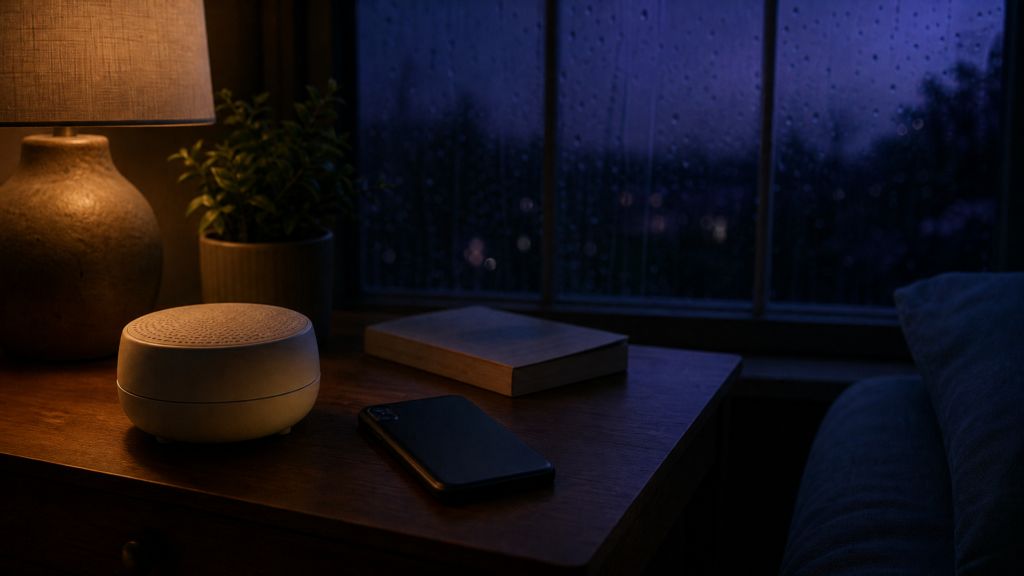
You do not need to buy anything, but two machines are worth knowing.
The LectroFan Evo is the comparison shopper’s pick. Its maker says it has 22 non-looping sounds, including brown, pink, and white noise, fan sounds, and two ocean sounds, so you can try all three colors on one box. Its maker’s manual also lists precise volume control and a timer of up to eight hours.
The Yogasleep Dohm Classic is the just-make-it-steady pick. Its maker says a real fan inside makes the sound, with no loops, no screen, two speeds, and a tone that adjusts from a deeper hum to a brighter rush of air. The maker’s comparison chart shows no sleep timer, so you switch it off yourself.
Where this page stops
This page is about sound, not medical advice or diagnosis, and no color can promise an easy night. Setting up a nursery? White noise for newborns covers babies: far from the crib, low, and short. Wide awake despite the perfect rumble? Why can’t I sleep? explains the get-up move, and What to do when you are awake in bed covers the middle of the night. Sleep hygiene tips that actually make sense and Why a cool, dark room helps cover the rest.
If you regularly have problems sleeping, the CDC’s advice is simple: talk to your healthcare provider.
Until then: pick by ear, keep it low, and give it an end. White, pink, or brown, the best color is the one you stop noticing.
Questions people ask
What is green noise, and does it help you sleep?
Green noise is an informal app label, not a standard color like white, pink, or brown. Descriptions vary, but it is often pitched as a pink-like sound with extra energy in the middle of the range. No good study shows it improves sleep. If you like the whoosh and it covers the hallway, that is reason enough.
Is brown noise or pink noise better for sleep?
Neither has been proven better. Pink sounds like steady rain, brown like a deep rumble or a distant waterfall. A 2021 review of 38 studies rated the evidence that continuous noise improves sleep as very low quality. Choose by ear and keep it low. If low sounds like a furnace bother you, brown may suit you.
Does pink noise boost deep sleep?
The lab studies behind that headline used brief sound pulses timed to sleepers’ slow brain waves, not a track playing all night. That is a different experiment from a pink noise video. So the honest answer is maybe in a lab setup, unknown for a loop on your phone. Enjoy it, just without the promise.
Are rain or ocean sounds the same as colored noise?
Close cousins. Many rain and ocean recordings land near pink or brown in how their energy is spread. The NHS lists background sounds like rainfall as something to try. The benefit is steadiness and a sound you enjoy, not a healing frequency. If sudden thunder cracks make you twitch, pick a steady downpour.
Sources
- Riedy et al., Sleep Med Rev, 2021 (PubMed): Noise as a sleep aid, a systematic review
- Ngo et al., Neuron, 2013 (PubMed): Auditory closed-loop stimulation of the sleep slow oscillation
- Papalambros et al., Front Hum Neurosci, 2017 (PubMed): Acoustic enhancement of sleep slow oscillations in older adults
- Cleveland Clinic, Can Pink Noise Help You Sleep?
- Cleveland Clinic, Brown Noise May Help You Focus and Relax
- Northwestern Medicine, Your Guide to White, Pink and Brown Noise
- NHS Every Mind Matters, How to fall asleep faster and sleep better
- CDC, About Sleep