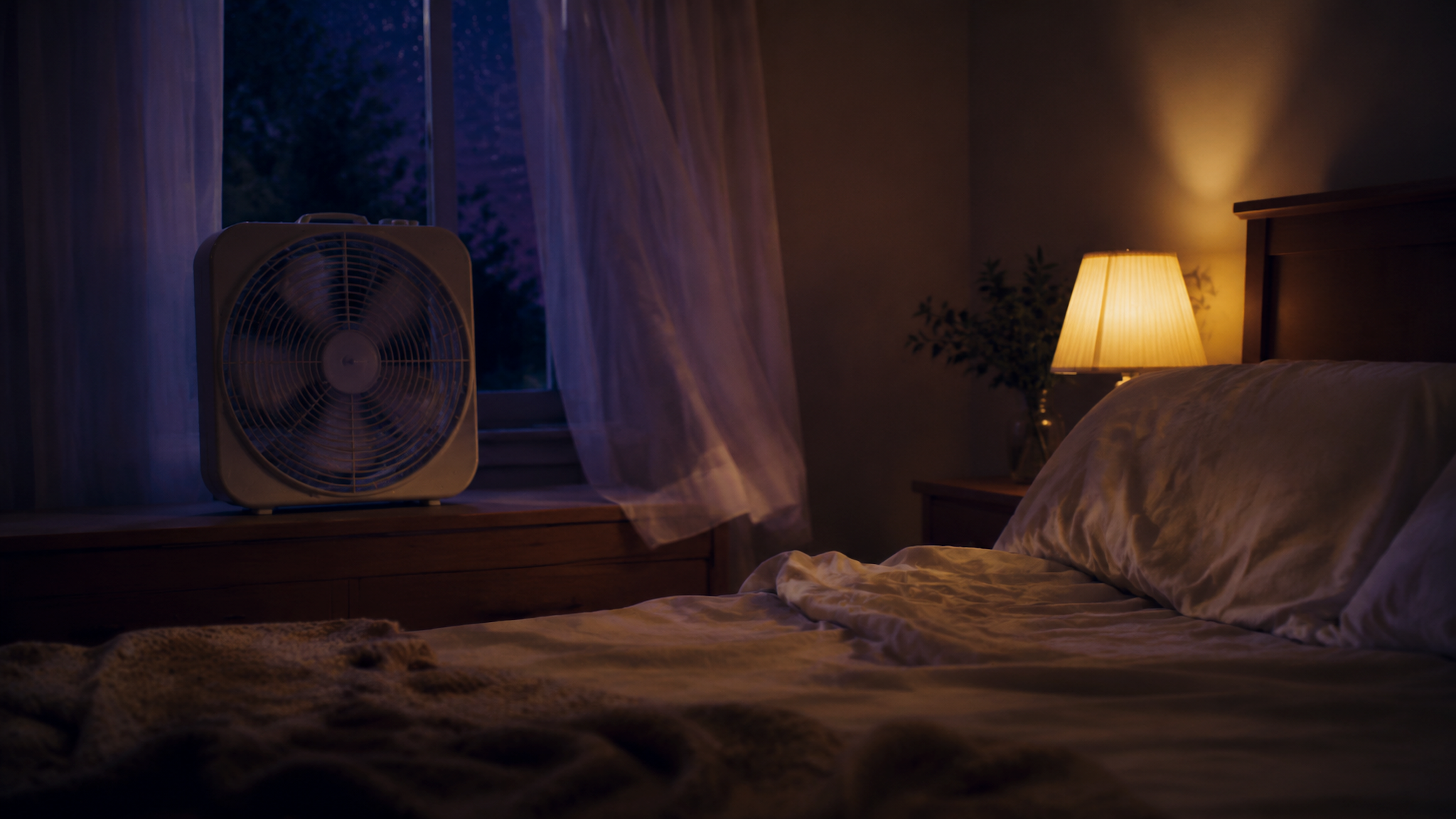
If you can’t sleep without a fan, you are not being superstitious. A fan does two useful things at once. Its steady hum covers the sudden noises that would otherwise wake you, and its moving air helps a warm room feel cooler. If your relationship with the box fan is the most stable one in the house, there is a reason. It is mostly physics plus habit.
Maybe you have packed it for a weekend away. Maybe it came up in the move-in negotiations, right after the couch. Either way, the fan stays.
Masking: the hum covers the slam
A quiet room makes every small sound stand out. A door closing down the hall. A partner’s cough. A truck downshifting outside. The neighbor’s dog clocking in for the night shift. Against near silence, each one is a spike, and spikes are what pull you up out of sleep or keep a short wake going.
A steady hum raises the floor. The same door still closes, but it has less silence to stand out against, so it lands as a smaller bump. That is masking, and it is the whole idea behind sound machines. NHLBI’s plain advice is to keep the bedroom quiet, cool, and dark. A fan is not literally quiet, but it trades unpredictable noise for one predictable sound, and plenty of people find that a good trade.
Now the honest part. The research on continuous noise as a sleep aid is thin. A 2021 review of continuous white and broadband noise rated the evidence that it improves sleep as very low quality, and it noted that this kind of noise could also work against sleep and hearing. So treat the fan as a comfort and a buffer, not a proven sleep treatment. If it helps you, keep it, and use it sensibly. Sleep hygiene tips that actually make sense covers the rest of the quiet, cool, dark room.
The cool side: moving air
Sound is only half of it. Sleep tends to start while core body temperature is falling, and that fall happens as heat leaves through the skin, especially the hands and feet. A warm, still room gives that heat nowhere to go. Heat during the night is also linked with more waking and less deep sleep.
Moving air helps carry warmth off your skin, so a stuffy room feels less sticky even before the thermostat has done anything. A sound machine cannot copy this part. It is also why fan arguments are rarely about noise. One of you runs warm, one of you runs cold, and the fan is simply where the disagreement lives.
The goal is comfortable, not colder. A gentle breeze plus covers you can push off does more than a gale that leaves you hunting for a blanket at dawn. Why a cool, dark room helps goes deeper on the temperature side.
How loud is too loud
There is no well-sourced decibel number for adult sleep, so this page will not invent one. The practical rule is comfortable, not hair dryer. If you have to raise your voice to talk over the fan from the bed, it is probably working harder than it needs to.
The same 2021 review is the reason to go easy. Continuous noise played too loud may cost you something for sleep and for your ears, so the top setting is not automatically the best one. If you love it loud, no judgment. Try one notch lower for a week and see whether you even notice.
Placement does a lot of the work volume would otherwise do. Put the fan a few feet away rather than right at your head. Aim it across the bed or toward a wall, so you get the hum and a little air without a wind tunnel on your face. A lower speed from across the room often masks just as well as a high speed up close.
A real fan or a fan-sound machine
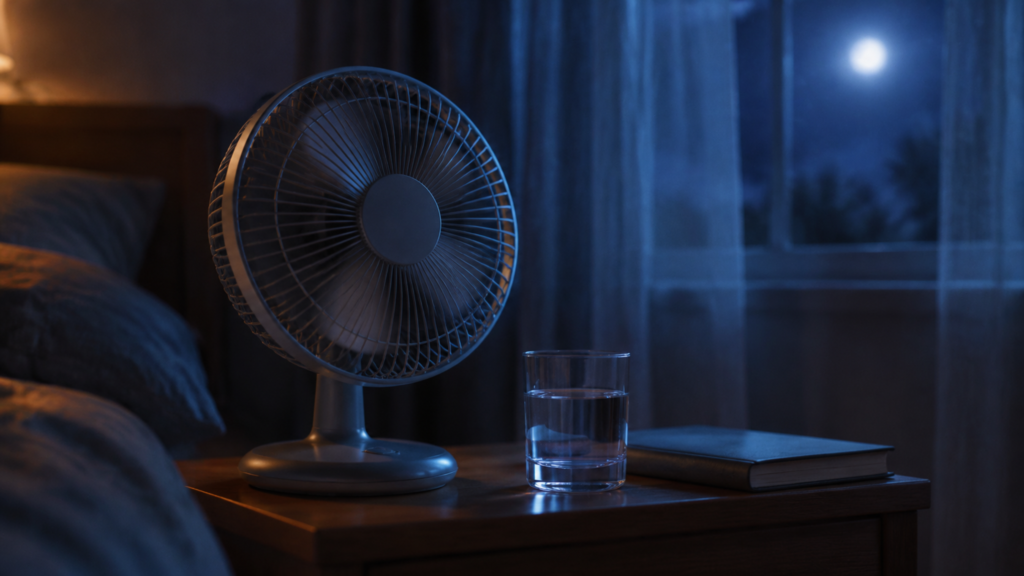
Box fan, tower, pedestal, circulator: they all move air and make a steady sound. If you searched for box fan noise for sleeping, the advice is the same as for any household fan. Placement and volume matter more than shape. A box fan on the floor across the room, on low, is a perfectly respectable setup. Nobody needs to upgrade a fan that already works.
If the room stays warm and still, a whole-room circulator such as the Vornado 660 moves air around the space instead of blasting one spot, which suits warm sleepers who want the cool feel and the hum together.
A fan-style sound machine is the other route. The Yogasleep Dohm Classic gives you that fan-like hum without a breeze on your face, which makes it a good friend to the cold-natured partner of a warm sleeper. One workable truce: the sound machine runs for both of you, and the warm sleeper adds a small fan aimed only at their side of the bed. Everyone keeps the hum, and only one person gets the weather.
Fan sound vs a rain or white-noise track
If you landed here looking for something to play, that is fair. Long rain, ocean, and white-noise tracks are easy to find on video sites and sleep apps. This page stays fan-first, and the difference is simple. A fan gives you sound plus moving air. A track gives you sound only.
If masking is all you need, say in a room that is already cool or a hotel with thin walls, a track can stand in nicely. If you sleep hot, keep the real fan, because a speaker will not cool anything. Past that, rain versus fan comes down to taste.
One practical note if the track lives on your phone: start it, then put the phone face down or across the room. The bright screen is a wake signal, and the sound does not need you to watch it.
Traveling without the house fan
The fan habit tends to show up most in hotel rooms, guest rooms, and anywhere with an unfamiliar hallway. Before you buy anything, check the room’s heating and cooling unit. If it has a fan-only setting, you may already have a hum and some air for free.
If you want to pack the habit, a small personal circulator such as the Vornado Passage charges over USB-C and folds flat, so it fits in a bag without a fight.
Some rooms do not allow airflow, or the person in the other bed hates a breeze. Dorm rules and shared rooms both count. For those nights, a pocket-size sound device such as the LectroFan Micro2+ plays fan-style sounds, and its maker lists other noise options too, so you keep the sound without the air.
Babies: a fan is not a newborn safety device
Everything above is for adults and older teens. A household fan is not a newborn safety device, and nothing on this page is advice for a crib. A box fan aimed at a crib is not safe infant sleep practice. The baby’s sleep space stays bare: no soft objects, and no devices in it.
Pediatric guidance on sound machines for babies is its own careful topic. It says to keep any machine far from the baby’s head and use it only for a short time. If you are setting up a nursery, follow that guidance and talk with your pediatrician, rather than borrowing the grown-up fan routine.
Where this page stops
A fan can make a room easier to sleep in. It does not treat insomnia or any other sleep problem, and it cannot promise how fast you will fall asleep. Some nights are still hard with the fan on. If you are lying awake and the clock-watching starts, What to do when you are awake in bed covers what helps.
If sleep is regularly a problem, talk with a healthcare provider. This page is not a diagnosis. In the meantime, keep it comfortable, keep it a few feet away, and yes, the fan stays.
Questions people ask
Is it bad to sleep with a fan on every night?
For most adults a fan is a comfort, not a problem. It masks sudden sounds and moves warm air off your skin. A 2021 review rated the evidence that steady noise improves sleep as very low quality, so treat it as a buffer rather than a treatment, and keep the volume comfortable.
How loud should a fan be for sleep?
There is no well-sourced decibel number for adult sleep, so the rule is comfortable, not hair dryer. If you have to raise your voice to talk over it from bed, turn it down. A 2021 review noted continuous noise may cost something for sleep and hearing, so the top setting is not automatically best.
Is a fan better than a white noise or rain track?
They do different jobs. A fan gives sound plus moving air. A track gives sound only. If masking is all you need, a track can stand in nicely. If you sleep hot, keep the real fan, because a speaker will not cool anything. Past that, rain versus fan is honestly a matter of taste.
Can I put a fan in my baby’s room for white noise?
A household fan is not a newborn safety device, and it never goes in or aimed at the crib. For babies, safe sleep basics come first: back to sleep, a bare crib, and any sound kept far from the baby, low, and short. Our white noise for newborns page walks through the AAP setup.
Sources
- NHLBI, Healthy Sleep Habits
- Riedy et al., Sleep Med Rev, 2021 (PubMed): Noise as a sleep aid, a systematic review
- Kräuchi, Sleep Med Rev, 2007 (PubMed): The thermophysiological cascade leading to sleep initiation
- Okamoto-Mizuno and Mizuno, J Physiol Anthropol, 2012: Effects of thermal environment on sleep and circadian rhythm
- HealthyChildren.org (AAP), How Noise Affects Children
- NIH Safe to Sleep, Ways to Reduce Baby’s Risk