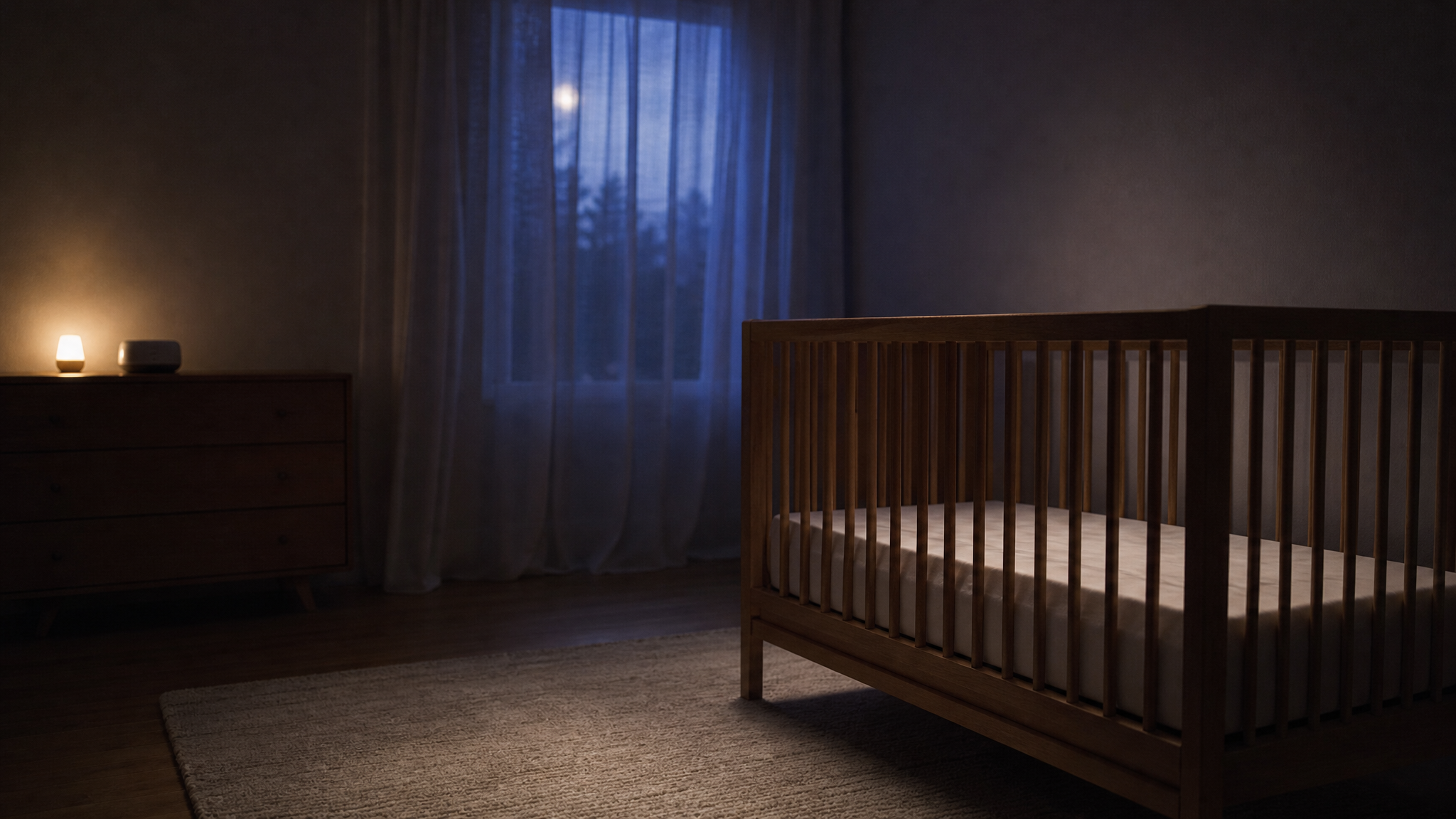
White noise is optional for a newborn, and if you use it, the safety is all in the setup. Advice from the American Academy of Pediatrics (AAP) is to place a sleep machine as far away from your baby’s head as possible and to use it for a short time only. Keep the volume low, keep the machine out of the crib, and keep the crib bare. No machine prevents SIDS.
White noise will not teach your newborn a schedule. Used carefully, it might keep the hallway from joining the wake-up. And if your dishwasher already runs every night, congratulations: you may own the household’s original sound machine.
Why a steady sound can help
Newborns sleep a lot in total, just not in long pieces. HealthyChildren, the AAP’s site for parents, notes that newborns sleep about 16 to 17 hours a day but may only sleep 1 or 2 hours at a time. That is a lot of chances for a sudden noise to land at the wrong moment. An older sibling’s door. The dog announcing a delivery. A sneeze from the next room that somehow sounds like a trumpet.
In a very quiet room, each of those sounds stands out sharply. A steady background sound raises the floor, so a sudden noise has less silence to stand out against. That is masking. The house is no quieter, but the changes in sound are smaller.
This is also why volume and distance matter so much. Masking works by adding sound to the room, and the sound you add reaches your baby’s ears too. Sound fades as it travels, so a machine across the room on a low setting adds much less to what your baby hears than the same machine beside the mattress. The goal is to soften the household, not to drown it out. Some families find a steady sound helps. Others do fine without one. Both are normal.
Safe sleep still comes first
Before any sound, the sleep space has to be right. These basics come from the NIH Safe to Sleep campaign and the AAP, and a sound machine changes none of them.
Your baby goes to sleep on their back, for naps and at night. The sleep surface is firm and flat, in a crib, bassinet, or portable play yard that meets Consumer Product Safety Commission standards, covered only with a fitted sheet. Your baby sleeps in their own space: the AAP recommends sharing a room for at least the first 6 months, but not a bed.
And nothing else goes in the sleep area. No pillows, blankets, bumpers, stuffed toys, or other items. Safe to Sleep puts it plainly: remove everything from the baby’s sleep area except a fitted sheet covering the mattress. That covers the sound machine too. It belongs in the room, not in the sleep space. A sound machine built into a plush toy is still a stuffed toy, so it stays out of the crib as well.
Does white noise prevent SIDS?
No. No sound machine, fan, app, or other product prevents SIDS. Safe to Sleep says it in five words: “No product can prevent SIDS.” The AAP also tells parents to be cautious about products that claim to reduce the risk of SIDS, because there is no evidence that they do.
So if a box or an ad hints that a machine makes your baby safer, treat that as marketing, not medicine. The steps that do help reduce risk are the safe sleep basics above, along with others your pediatrician can walk you through.
What the 2014 study measured
In 2014, a team at the University of Toronto tested 14 infant sleep machines and published the results in the journal Pediatrics. They played each machine at its maximum volume and measured the sound at 30, 100, and 200 centimeters away. That is roughly one foot, a bit over three feet, and about six and a half feet.
At the closest distance, the authors wrote: “Maximum sound levels at 30 cm were >50 A-weighted dB for all devices, which is the current recommended noise limit for infants in hospital nurseries.” They also found that “Three machines produced output levels >85 A-weighted dB, which, if played at these levels for >8 hours, exceeds current occupational limits for accumulated noise exposure in adults and risks noise-induced hearing loss.” Their conclusion was that these machines “are capable of producing output sound pressure levels that may be damaging to infant hearing and auditory development.”
Two fair notes. The study measured maximum volume, so it does not mean every machine is harmful at every setting, and those numbers are not a target for your nursery. This page will not invent one. Also, not every hearing expert read the study the same way. One pediatric audiologist quoted at the time thought it may have overestimated what babies actually hear. Either way, close and loud is the setup to avoid, and distance plus a low setting are your two easiest protections.
How to set up a sound machine, if you use one
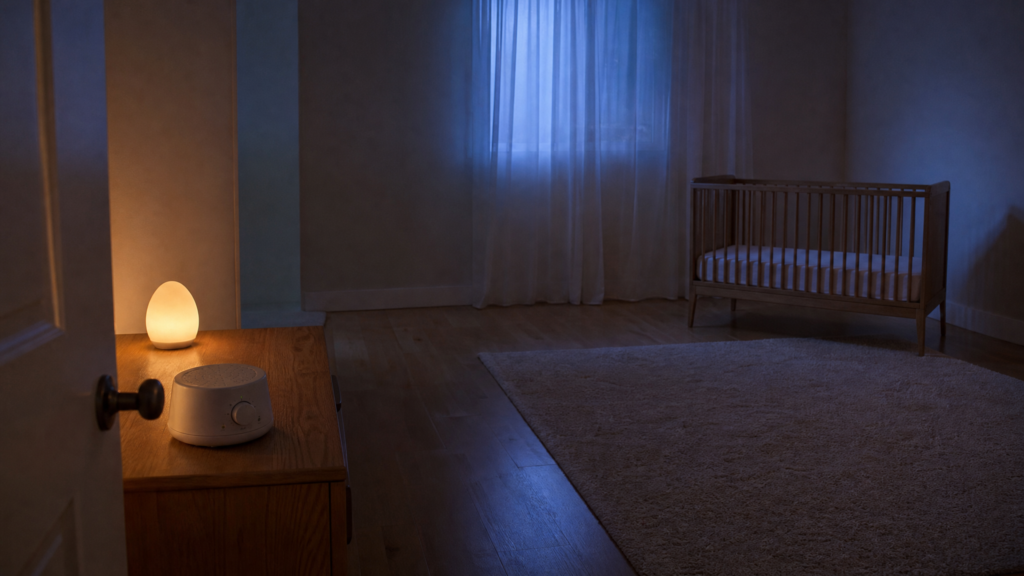
Start with the room, not the machine. Put the sound machine on a dresser or shelf on the far side of the room, as far from your baby’s head as the room allows. Not on the crib rail, not tucked by the mattress, not inside the crib. The Toronto researchers advised families to place machines well away from the baby and never in the crib or on the crib rail, and the bare-crib rule from Safe to Sleep says the same thing from the other direction.
Mind the cord. The machine and its cord should sit well out of reach of the crib, with nothing draped over the rail or running into the sleep space.
Turn it down before you turn it on. Start at the lowest setting and only go up if household noise is still getting through. Then stand where your baby’s head will be and listen. It should sound like a soft background, not something you would need to talk over.
Give it an end. Use the timer if the machine has one, or switch it off yourself once your baby is settled or the loud part of the evening is over. The AAP’s advice is a short time only, so all night, every night, at full volume is the opposite of the guidance.
If you room share, as the AAP recommends for at least the first 6 months, the machine lives in your room. Put it on a dresser across the room from the bassinet, at a level you barely notice.
What low and short look like in practice
Guidance for parents does not give a decibel number for a home nursery. In plain terms, low means barely there. Standing at the crib, it should be softer than a quiet conversation. If you would have to raise your voice to talk over it at the crib, it is too loud.
Short means a tool for a stretch, not a soundtrack for the whole night. Use it to cover the busy part: bedtime while older kids are still up, a nap during daytime traffic, or the hour the dishwasher decides to sound like a jet engine. When that stretch passes, the machine can go off.
Picks: room machines only
If you decide to try a machine, look for one that sits across the room and makes it easy to stay low and to stop. Skip anything designed to clip onto the crib or live inside a plush toy.
The Yogasleep Dohm Classic is the simple choice. A real fan inside makes a steady, non-looping hum, with two speeds and a twist cap that adjusts the sound, and there is no screen to light up the room. It has no timer, so plan on switching it off yourself. Same rules as any machine: far from your baby’s head, low, and short.
The LectroFan Evo suits apartments and busy streets, when you want more choice. Its maker lists 22 non-looping sounds, including white, pink, and brown noise and fan sounds, plus precise volume control and a built-in timer. Fine volume steps make low easier to keep low, and the timer gives short an automatic end. It still goes on a dresser across the room, never on or in the crib.
Already have a fan humming somewhere? Fan noise for sleep covers the grown-up fan habit. In a nursery, a fan follows the same rules as any other device: it stays outside the sleep space, and it is not a SIDS tool.
Where this page stops
This page is about sound and setup. It is not medical advice, and it is not a sleep-training plan. If you have questions about your baby’s sleep, hearing, or settling, talk with your pediatrician. They know your baby, and they have the most up-to-date safe sleep guidance.
And for you, the tired grown-up: if you are lying awake after a night feed, What to do when you are awake in bed has a few calm ideas, and Sleep hygiene tips that actually make sense covers your own side of the night. You are doing a lot. A soft hum across the room is allowed to help a little.
Questions people ask
Is white noise safe for newborns?
It can be used safely if the setup is careful. HealthyChildren, from the AAP, advises placing a sleep machine as far from your baby’s head as possible and using it for a short time only. Keep the volume low and the machine out of the crib. White noise is optional, and many babies do fine without it.
Can white noise prevent SIDS?
No. No sound machine, fan, app, or other product prevents SIDS, and Safe to Sleep says so directly: “No product can prevent SIDS.” What Safe to Sleep and the AAP recommend instead are the safe sleep basics: baby on their back, on a firm flat surface with only a fitted sheet, in their own sleep space.
How far from the crib should a sound machine be?
As far from your baby’s head as the room allows, such as a dresser on the other side of the room. Never on the crib rail, by the mattress, or inside the crib. A 2014 Pediatrics study found many machines at maximum volume were loud at about one foot away, so distance and a low setting matter.
How loud should white noise be for a baby?
Low. Sources do not give a safe decibel target for home use, so this page will not invent one. A practical check: the sound should soften household noise, not drown it out, and you should be able to talk quietly over it. Keep it far from the crib and run it for a short time.
Sources
- HealthyChildren.org (AAP), How Noise Affects Children
- Hugh et al., Pediatrics, 2014 (PubMed): Infant sleep machines and hazardous sound pressure levels
- Hearing Health Matters, Parents are cautioned that sleep machines may be a threat to infants’ hearing (2014)
- NIH Safe to Sleep, Ways to Reduce Baby’s Risk
- HealthyChildren.org (AAP), How to Keep Your Sleeping Baby Safe: AAP Policy Explained
- AAP Policy Statement, Sleep-Related Infant Deaths: Updated 2022 Recommendations (Pediatrics)
- HealthyChildren.org (AAP), Getting Your Baby to Sleep