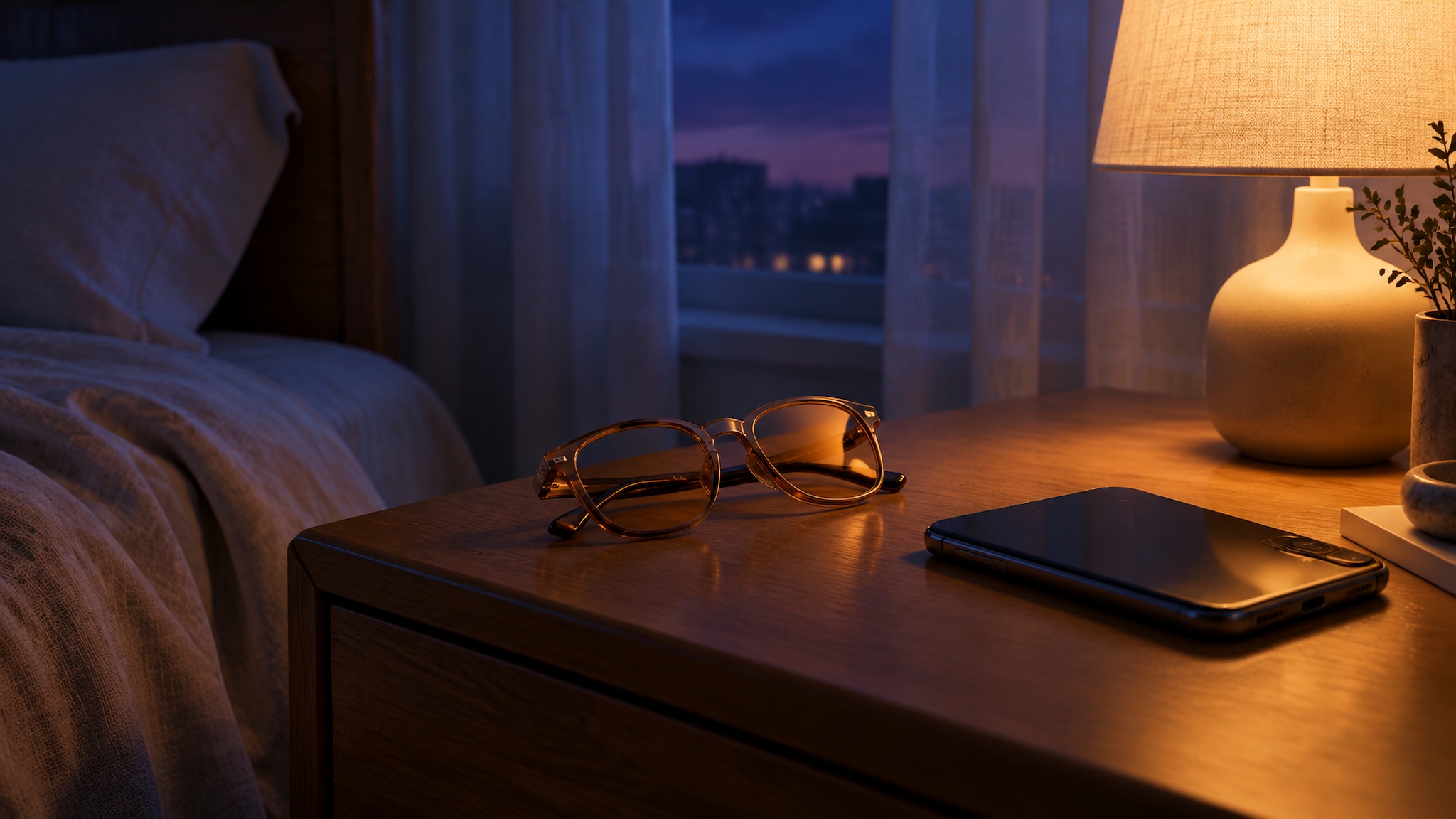
Blue light glasses might help some people wind down, but the evidence that they improve sleep is mixed and weak. A 2023 Cochrane review of the research could not say whether they beat ordinary lenses for sleep quality, and it rated that evidence very low certainty. What is better supported is the simple part: bright light in the evening can make it harder to fall asleep. So start by dimming the room, and treat glasses as an optional extra you can test on yourself.
Your phone will happily show you ads for sleep glasses before it dims itself. Start with the dimmer. Then decide whether amber lenses earn a spot on the nightstand.
What evening light does to your body clock
Your eyes do more than see. The National Institute of Neurological Disorders and Stroke (NINDS) explains that specialized cells in the retina process light and tell the brain whether it is day or night. That signal goes to a small cluster of cells in the brain that sets your daily rhythm, which then signals the pineal gland to make melatonin, a hormone that helps you feel sleepy when it gets dark.
NINDS also says light exposure can make it harder to fall asleep, and harder to get back to sleep if you wake up. The National Heart, Lung, and Blood Institute (NHLBI) suggests using the hour before bed for quiet time and avoiding bright artificial light, such as from a TV or computer screen, because that light may signal the brain that it is time to be awake.
Researchers single out blue light because, as one trial put it, blue wavelengths are the most potent part of visible light for setting the body clock. That is the whole idea behind the glasses: filter the blue, and maybe the brain gets more of a night signal.
Clear “computer” lenses vs. amber evening lenses
“Blue light glasses” covers two very different things. Clear or lightly tinted computer lenses are made for daytime screen use and filter only a portion of blue light. Deep amber or orange lenses are designed to filter more of it, and they make the world look like a sunset. The small sleep trials that found a benefit used amber lenses in the evening, not clear daytime ones. If a pair looks almost clear, it is not the pair those studies tested.
What the Cochrane review found
Cochrane reviews pool the best trials on a question. The 2023 Cochrane review on blue-light filtering lenses included 17 trials. For sleep quality, the findings split down the middle: across six trials with 148 people, three found better sleep scores with blue-light filtering lenses and three found no difference. The authors said they do not know whether these lenses are equal or better than regular lenses for sleep, and they rated that evidence very low certainty.
A few more details are worth knowing. According to the plain-language summary, none of the included studies measured melatonin levels in the blood, so the melatonin story on the box has not been checked that way in these trials. The review also found the lenses may not reduce short-term eye strain from computer work compared with ordinary lenses. “Maybe” is the honest answer here, and maybe is a complete sentence.
The small amber trials: interesting, not proof
Two small studies often come up. In a 2009 trial, 20 adults wore either amber glasses or yellow-tinted glasses that blocked only ultraviolet light for 3 hours before sleep. The amber group reported better sleep quality by the end, based on sleep diaries. The authors said the study should be repeated with objective measures.
In a 2018 trial from Columbia University, 14 people with insomnia symptoms wore amber or clear lenses for 2 hours before bed for a week each. Sleep scores and some sleep measures were better in the amber week. That is encouraging, and it is also 14 people for one week.
Free fixes to try first
- Dim the room. In the last hour, switch off big overhead lights and use one low, warm lamp. This works on all the light around you, not just the screen.
- Give screens an earlier exit. NHLBI’s quiet hour means no bright TV or computer screen. If that is not realistic tonight, start with the last 20 minutes and grow it.
- Use night mode, and lower the brightness. It is free and it warms the screen, but it only changes the screen, not the lamp above you.
- Remember the daytime half. Light timing works across the whole day. More on that in Why morning light helps the night.
Gamers, students, and shift workers
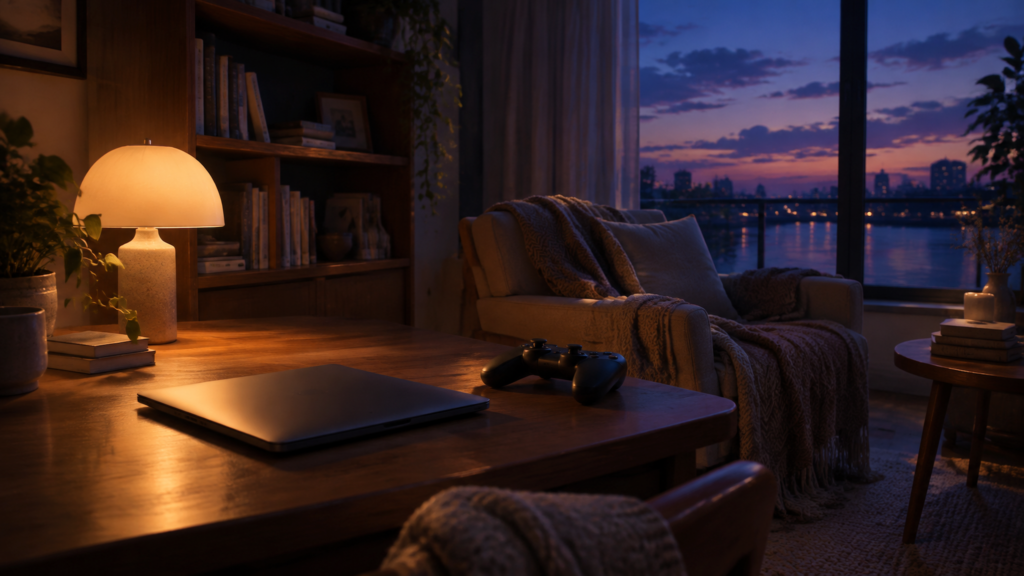
Gamers: the late match is rarely just light. It is also excitement, and the “one more round” that turns into five. A pair of amber glasses will not lower your heart rate after a clutch win. Dim the room, end on a calmer game, and give yourself a few minutes before bed.
Students: if the laptop has to stay open late, lower the screen brightness, turn on night mode, and swap the ceiling light for a desk lamp. Then close it before bed, even for a short buffer.
Shift workers: NHLBI suggests keeping lights bright at work and removing light from your bedroom during daytime sleep, for example with light-blocking curtains. If you still cannot fall asleep during the day, NHLBI suggests talking with your doctor about other options.
If you still want to try amber glasses before bed
That is a fair experiment. The trials had people wear amber lenses for 2 to 3 hours before bed, so that is the pattern to copy. It is a trial pattern, not a medical routine. Give it a week or two, keep a simple note of how you slept, and be honest with yourself about whether anything changed.
Some picks people try:
- Swanwick Sleep Swannies Classic, a dedicated amber pair made for evening wear.
- Uvex Skyper SCT-Orange (S1933X), a cheap orange wraparound. You will look like you are about to weld something at dinner. It is a low-cost way to find out if amber lenses do anything for you.
- Philips Hue White Ambiance bulbs, if you would rather change the room than your face. Warm, dimmable light in the evening helps everyone in the house.
Night mode or glasses? Night mode is free and only warms the screen. Amber lenses filter light reaching your eyes from every source, screen and lamp alike. Neither one has been proven to fix sleep for everyone.
When to talk to someone
This page cannot diagnose a sleep problem. If you regularly struggle to fall or stay asleep, or tiredness is getting in the way of your days, talk with a healthcare provider. No pair of glasses should stand in for that. For more on the basics, see Sleep hygiene tips that actually make sense and Why can’t I sleep?
Questions people ask
Do blue light glasses actually help you sleep?
The evidence is mixed and weak. A 2023 Cochrane review could not say whether blue-light filtering lenses beat ordinary lenses for sleep quality, and rated that evidence very low certainty. What is better supported is simpler: bright evening light can make it harder to fall asleep. Dim the room first, then test glasses if curious.
Are amber glasses different from clear blue light glasses?
Yes. Clear or lightly tinted computer lenses filter only part of the blue light and are made for daytime screens. Deep amber or orange lenses filter more and make everything look like sunset. The small sleep trials that found a benefit used amber lenses in the evening, not the nearly clear daytime kind.
Is night mode as good as blue light glasses?
Night mode is free and warms the screen, but it changes only the screen, not the lamp overhead. Glasses filter everything you see, though the sleep evidence for them is thin. The most reliable step is the boring one: dim the room in the last hour and give screens an earlier exit.
Sources
- NINDS, Brain Basics: Understanding Sleep
- NHLBI, Healthy Sleep Habits
- Singh et al., Cochrane Database of Systematic Reviews, 2023 (PubMed): Blue-light filtering spectacle lenses
- Cochrane, plain-language summary of the 2023 review
- Burkhart and Phelps, Chronobiology International, 2009 (PubMed): Amber lenses to block blue light and improve sleep
- Shechter et al., Journal of Psychiatric Research, 2018 (PubMed): Blocking nocturnal blue light for insomnia